
Cosmetic & Smile
Dental Crowns & Bridges
All-ceramic crowns and fixed bridges that restore cracked, heavily worn, or missing teeth with a natural-looking, long-lasting result.
Free consultation · Written estimate at the visit
- Time
- Crowns 2 visits · Bridges 2 visits
- Recovery
- Same-day return to normal activity
- Cost
- Crowns from $900 · 3-unit bridges around $2,800–$3,100 Most plans cover 50–80% after deductible Coverage varies by plan. Some have waiting periods for major restorative work and an annual maximum that resets each year. Payment plans from $99/mo via CareCredit →
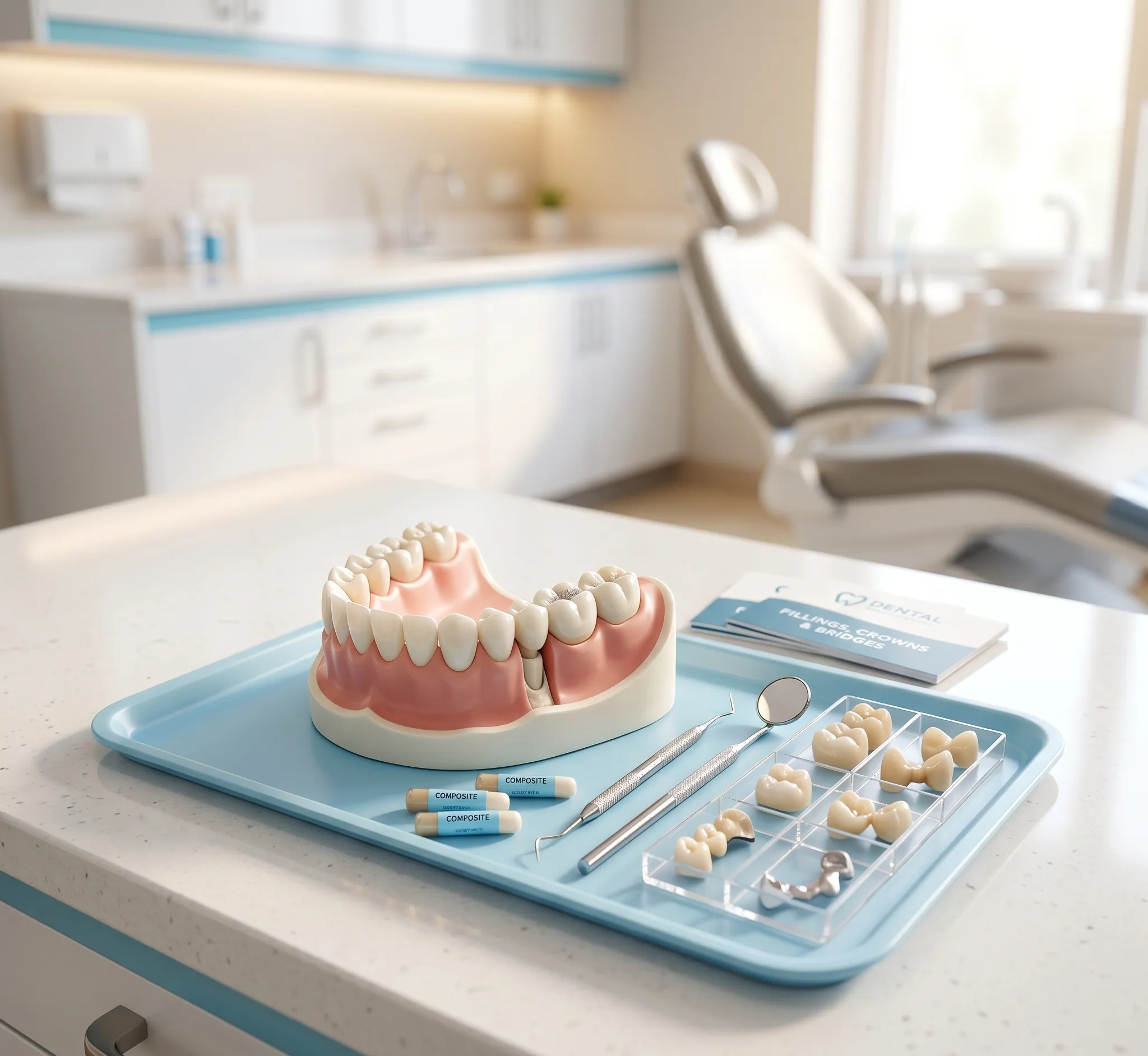
When a tooth is too damaged for a filling, a crown caps the whole tooth and brings it back to full function. When a tooth is missing entirely and the neighboring teeth are healthy, a fixed bridge fills the gap. Royale Dental in Hialeah uses all-ceramic and zirconia materials — no metal lines, no gray shadow at the gum, lifelike translucency. Bilingual care, modern materials, long-lasting craftsmanship.
When each is the right choice
- Crown — a tooth that’s cracked, heavily worn, root-canal-treated, or has lost so much structure a filling won’t hold. The crown caps the entire visible portion of the tooth and protects what’s left.
- Inlay or onlay — a step between a filling and a full crown for moderately damaged teeth. A fabricated ceramic piece bonds into the prep more conservatively than a full crown. Sometimes called “partial crowns.”
- Bridge — one or two adjacent teeth missing, with healthy neighboring teeth strong enough to be prepped for crowns and anchor a replacement tooth between them.
- Implant + crown — preferred over a bridge when you want to avoid grinding down the neighboring teeth. The implant replaces the missing tooth at the root and supports its own crown.
For small to moderate cavities that haven’t damaged the tooth structure beyond a filling, see our tooth-colored fillings page instead.
Who may not be a good candidate: Active gum disease or uncontrolled bone loss must be treated before a crown or bridge is placed — the restoration needs healthy supporting tissue. Severe uncontrolled grinding (bruxism) significantly increases fracture risk for all-ceramic crowns; we discuss nightguard protection and material selection based on your bite. Teeth with inadequate remaining structure may need a buildup or, in some cases, may not be restorable at all — we’ll tell you honestly if extraction and an implant is the better path. For bridges specifically: preparing the anchor teeth permanently removes enamel from healthy neighboring teeth, which is an irreversible step; an implant avoids this trade-off entirely.
Materials we use
- Lithium disilicate (e.max) — high-translucency all-ceramic for highly aesthetic front crowns
- Zirconia — exceptionally strong all-ceramic, ideal for back-tooth crowns and multi-tooth bridges where chewing forces are highest
- Porcelain-fused-to-metal (PFM) — a traditional crown material we use selectively when strength under specific bite conditions matters more than maximum translucency
We’ve moved away from gold and silver-amalgam restorations on aesthetic grounds, but the clinical evidence for both remains strong — there’s no quality concern with the older materials, just a visible one.
What the visit looks like
Crown (all-ceramic)
- Visit 1. Local anesthetic, decay removal, shape the tooth for the crown, take a digital scan, place a temporary crown.
- Lab fabrication. The lab returns the permanent crown in 1–2 weeks.
- Visit 2. Try-in, fit and shade verification, cement the crown, check the bite, polish.
Bridge
- Visit 1. Prepare the two anchor teeth on either side of the gap for crowns, take a digital scan, place a temporary bridge.
- Lab fabrication. 1–2 weeks.
- Visit 2. Try-in, fit and shade verification, cement the bridge, check the bite, polish.
Benefits and outcomes
- Natural appearance. No metal lines, no gray shadows under the gum, lifelike translucency.
- Long service life. Peer-reviewed studies report ~92–93% of ceramic crowns still in service at 10 years (Pjetursson et al., 2018). Longevity varies by position (front vs. back), bite forces, grinding habits, and home care.
- Restored function. Full chewing strength, normal bite, and protection of the underlying tooth or the gap between teeth.
- Better hygiene. Smooth, contoured restorations are easier to clean than rough or ill-fitting older work.
Not sure if your tooth needs a crown or can still be saved with a filling? Book a free consultation — we examine the tooth, take any needed x-rays, and give you a written estimate. No obligation until you approve the treatment.
Cost and financing
Free consultation included — we examine the tooth, take any x-rays needed, and hand you a written estimate with insurance applied before you decide on treatment.
Crowns at Royale Dental are $900–$1,030 per tooth depending on the material — porcelain-fused-to-base-metal crowns sit at the lower end of the range and full porcelain/ceramic crowns at the upper end. Payment plans from around $99/mo through CareCredit and Alphaeon spread the cost over 6–24 months. A standard 3-unit bridge (two anchor crowns plus one replacement tooth) typically runs around $2,800–$3,100 before insurance. Larger or specialty bridges are priced per unit and quoted in writing before treatment begins.
Most dental plans cover restorative work as basic or major care — typically 50–80% after deductible, up to the annual maximum. Bring your card and we’ll verify benefits in about 60 seconds, then hand you a written estimate before any work starts.
Patients come to our Hialeah office for crowns and bridges from Doral, Miami Lakes, Coral Gables, and Westchester — restorative dental pricing in South Florida varies widely, and many patients find a significant difference compared to quotes from Miami Beach or downtown Miami offices.
Long-term value
A well-placed crown or bridge keeps a tooth functional for a decade or more. When choosing between a bridge and an implant for a missing tooth, the upfront cost of an implant is higher, but the lifetime cost is often lower because implants tend to last considerably longer than the 10–15 year typical lifespan of a traditional bridge. Implants vs. Bridges and Single-tooth vs. full-arch implants walk through the math case by case.
Restorative work lasts longest when the rest of the mouth is healthy. We pair every restorative visit with tailored home-care guidance, the right floss or interdental brush for the restoration shape, and the six-month hygiene schedule that protects everything.
Not sure yet? Get a written estimate first
If you’re weighing a crown vs. an onlay, or a bridge vs. an implant, book a free consultation. We’ll examine the tooth, take any x-rays needed, and hand you a written estimate with insurance applied before you decide on treatment. Bilingual care in Hialeah, insurance verified in 60 seconds, payment plans available.
Common questions
Frequently asked about Dental Crowns & Bridges
-
When do I need a crown instead of a filling?
A crown is the right choice when a tooth has lost too much structure for a filling to hold — typically a tooth that's heavily decayed, cracked, root-canal-treated, or has a large old filling that's failed. If a filling would only fill a fraction of the tooth and leave fragile walls behind, a crown caps the whole visible portion of the tooth and protects what's left. We'll explain why a crown is the right call and give you a written estimate before deciding. For smaller cavities, see our tooth-colored fillings page. -
How long do crowns and bridges last?
With good home care and routine cleanings, modern all-ceramic and zirconia crowns typically last 10–15 years or more — peer-reviewed studies report roughly 92–93% still in service at 10 years (Pjetursson et al., 2018). The supporting tooth (or teeth, for a bridge) needs to stay healthy — decay or gum disease under a crown is the most common reason a restoration fails early. We monitor the fit and the supporting structure at every six-month exam. -
Is a bridge or an implant the better choice?
A bridge requires grinding down the two healthy neighboring teeth to anchor the crowns — that's the trade-off. A single-tooth implant replaces the missing tooth without touching the neighbors, preserves the bone underneath, and tends to last longer. Long-term studies report implant survival above 90% at 20 years, while traditional bridges typically last 10–15 years before they need redoing (NIH-indexed systematic review). Implants vs. Bridges covers the comparison in detail. Implants cost more upfront but often less over a lifetime. -
Will my crown match my other teeth?
Yes. We use shade-matching technology and lifelike all-ceramic materials (e.max, zirconia) that mimic the translucency of natural enamel. For a single visible front tooth, color matching is the harder challenge — we sometimes do a try-in stage so you approve the shade before the crown is bonded. Back teeth are easier; we focus there on durability and bite alignment. -
How long does it take to get a crown?
Two visits about 1–2 weeks apart. At the first visit we shape the tooth, take a digital scan, and place a temporary crown. The lab fabricates your final crown. At the second visit we try-in, verify the fit and shade, then cement the permanent crown and check the bite. Each appointment is about 60–90 minutes. -
Does the crown procedure hurt?
Most patients feel pressure but no pain during prep — local anesthetic is placed before any shaping begins. There are situations where achieving complete numbness takes a bit more anesthetic (inflamed or infected teeth can be harder to numb fully), but we pause and add more until you're comfortable. The numbness usually wears off in 2–4 hours. Mild sensitivity to cold or biting for a few days afterward is normal as the tooth settles. If it persists past a week or you feel sharp pain when biting, call us — typically the bite just needs a small adjustment. -
How much does a dental crown cost in Hialeah, FL?
At Royale Dental, crowns are $900–$1,030 per tooth depending on the material — porcelain-fused-to-metal crowns sit at the lower end, full ceramic and zirconia crowns at the upper. A standard 3-unit bridge runs $2,800–$3,100 before insurance. Most dental plans cover restorative work at 50–80% after your deductible. Bring your card and we'll verify benefits in about 60 seconds. Payment plans through CareCredit and Alphaeon are available from around $99/mo.
Also at Royale Dental
Related Services
-
Cosmetic & Smile
Dental Implants
Permanent, natural-looking replacement for missing teeth — single, multiple, or full arch.
Learn more → -
Cosmetic & Smile
Full, Partial & Snap-In Dentures
Custom-fit removable dentures — full arch or partial — that look natural and stay comfortable.
Learn more → -
Cosmetic & Smile
Invisalign® Clear Aligners
Straighten your smile with clear aligners most people never notice — most cases finish in 6–18 months, and you eat whatever you want throughout.
Learn more →
Payment plans available
Spread treatment over 12–60 months
Two healthcare-specific lenders most patients use. Apply in minutes — decisions are usually instant. We walk through both at the consultation so you pick the one that fits your situation.
CareCredit
0% promotional financing for 6, 12, 18, or 24 months on qualifying purchases. Fast online application with instant decisions.
ApplyAlphaeon Credit
Soft credit pre-qualification — check your rate without affecting your credit score. Lines up to $25,000.
Pre-qualifyTrusted in Hialeah
Why families choose Royale Dental
10+ years
Caring for Hialeah since 2016
4.9
Google rating · 54 reviews Read patient reviews
Most insurance
Verified in 60 seconds at the visit
” Very profesional attention and quality. ”
” Excelente servicio 👏👏 ”
” Super ”
” Súper recomendado muy amables y excelentes servicios. ”
” Mi experiencia muy buena un trato bien amable de todo el personal muy satisfecha ”
Ready to start Dental Crowns & Bridges?
Free consultation. Written estimate at the visit, no obligation.
Free consultation · Written estimate at the visit