Dental Implants vs Bridges: 10/20-Year Survival & Cost
Implants vs bridges by the numbers: 96.4% vs 89.2% 10-year survival, bone loss, peri-implantitis risk, and real Hialeah costs. No-obligation consult.
By Royale Dental · May 18, 2026
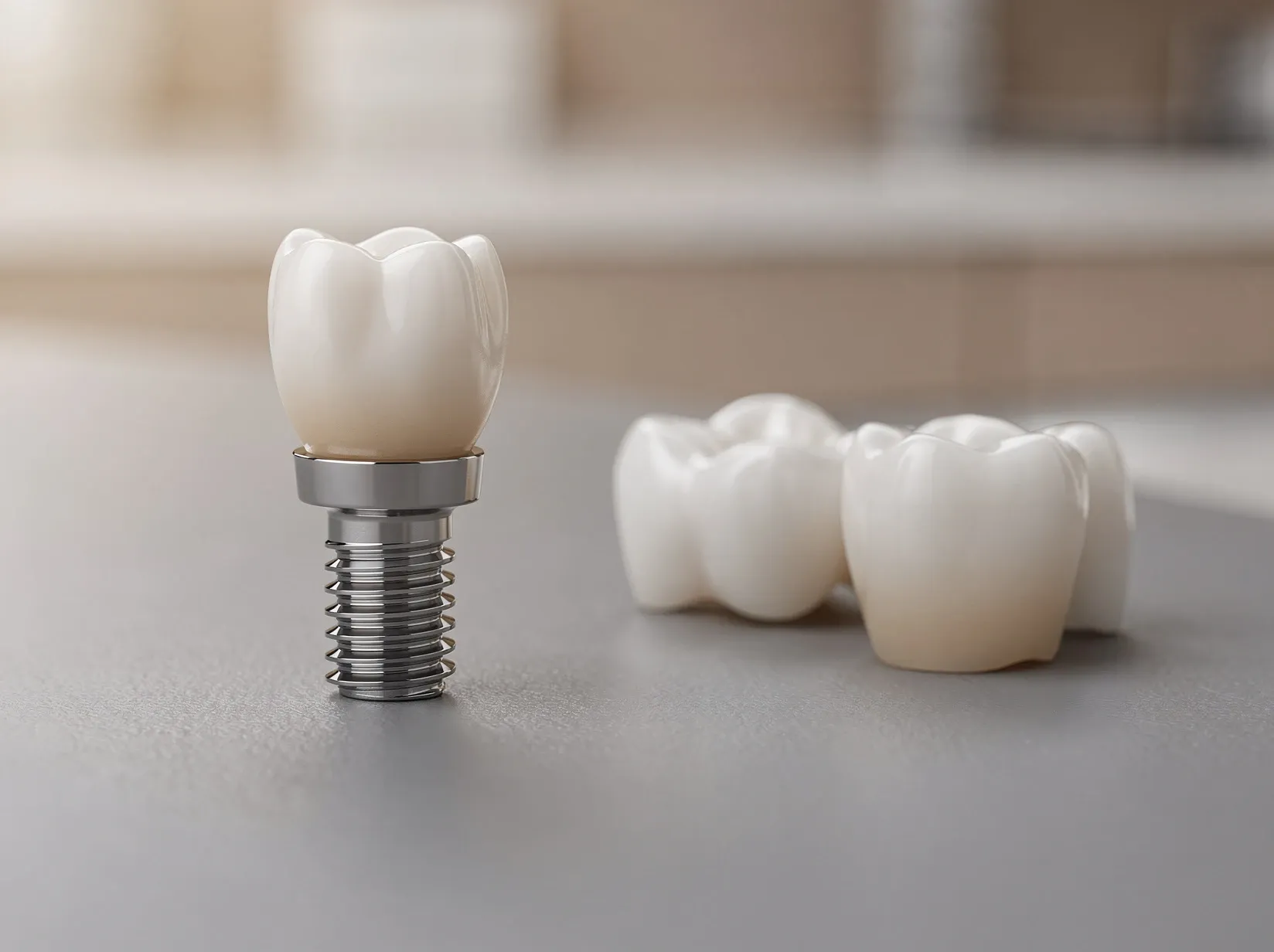
You lost a tooth, or one is about to come out. Your dentist mentions two paths: a dental implant or a bridge. The dental implants vs bridges question has decades of track record on both sides — and the two options are very different bets on the next twenty years of your mouth.
This guide pulls together eleven systematic reviews on that exact question. The numbers are not abstract. They will help you decide whether to drill on healthy neighbor teeth and how much you are really paying once the dust settles.
If you live in Hialeah or anywhere in Miami-Dade, you can also bring this to Royale Dental for a written estimate on both options. Bilingual care, no pressure to pick today.
The short version: what the research actually shows
At ten years, single dental implants survive at about 96.4%. Traditional three-unit dental bridges survive at about 89.2%. Both numbers come from the same head-to-head review.
That gap is real, but not the whole story. The right choice depends on your bone, your gums, the teeth next door, and your lifestyle. Numbers in the abstract do not decide your case. Your X-rays do.
A few headline findings up front:
- About 4 in 5 implants are still working at 20 years.
- Bridges and implants fail differently, not less often. Both run a complication-free rate around 69% at ten years.
- A bridge requires grinding down two healthy teeth. An implant does not touch them.
- Bone keeps shrinking under a bridge. An implant slows that loss because it loads the bone like a root.
One more thing before the data: a single, well-placed implant often outlasts two cycles of bridge replacement.
Survival and longevity by the numbers
Survival rate just asks one thing: is the restoration still in the mouth and working at the follow-up visit? Here is how the two paths compare across the major reviews.
| Time point | Implant single crown | Implant-supported bridge | Tooth-supported 3-unit bridge |
|---|---|---|---|
| 5-year survival | 94.5% | 95.2% | 93.8% |
| 10-year survival | 89.4% | 86.7% | 89.2% |
| 20-year survival | 78–92% (range) | — | — |
At five years the three options are essentially tied. The real divergence shows up later.
The 2024 twenty-year meta-analysis from Clinical Oral Investigations put implant survival at 92% on complete cases, and 78% after adjusting for patients who dropped out. Plain framing: roughly four out of five implants survive two decades.
Headline survival rates also hide repair work. A 10-year bridge survival of 89.2% looks great until you read that only about 63% of those bridges made it to ten years without any complication. The restoration is still there. It just needed fixing along the way.
One more note. The 10-year implant review flagged a possible doubling of implant loss risk in patients 65 and older.
What bridges do to the teeth next door
This is the comparison that surprises patients most.
A three-unit bridge anchors a false tooth (the pontic) onto crowns over the two healthy teeth on either side of the gap. Those neighbor teeth are called abutments (anchor teeth). To fit a crown over them, your dentist must remove a lot of healthy tooth structure.
How much? Full-coverage crown preparations on back teeth remove 67.5% to 75.6% of the abutment tooth. A conservative bonded preparation removes only about 5.5%.
That structural loss has consequences. In long-term follow-up of three-unit bridges, about 1 in 3 abutment teeth (32.6%) lost vitality during the bridge’s lifetime. Losing vitality means the nerve died, which usually leads to a root canal, a new crown, or extraction. Other common bridge complications include cavities at the crown margin (9.1%) and the bridge coming loose (16.1%).
An implant does not touch the neighbors. The titanium post sits in its own socket in the bone. The teeth on either side stay flossable and untouched.
When does a bridge still make sense for the neighbor teeth? When they already need crowns. If the teeth on either side have large fillings or existing crowns, you would be capping them anyway.
The bone-loss argument for implants
When you lose a tooth, the jawbone underneath starts to disappear. Your body reads “no tooth here” as “no need to maintain bone here,” and the ridge collapses.
The pace is faster than most patients expect. A systematic review of post-extraction healing in Clinical Oral Implants Research measured an average 3.79 mm of horizontal bone width loss at six months. Vertical bone height on the cheek side lost about 1.24 mm in the same window. After that the loss slows but never stops.
A bridge does not address this. The pontic sits above the gum. Chewing force lands on the crowns over the neighbor teeth, not on the bone where the missing tooth used to be. The ridge keeps shrinking under the bridge year after year.
An implant does what a natural tooth root does. It transmits load into the bone, which signals the body to maintain it. Implants do not fully stop bone resorption, but they slow it down. This is also why long-time denture wearers often see facial collapse along the jawline.
Missing more than one tooth? The math changes again. We cover that case in single tooth vs full-arch implants.
The real long-term risk for implants — peri-implantitis
Implants do not get cavities. They have a different long-term risk: peri-implantitis (gum infection around an implant).
A 2022 review of 57 studies put patient-level peri-implantitis at about 19.5% — roughly 1 in 5 implant patients. At the level of individual implants, the rate drops to about 12.5%. The prevalence stays stable past five years, so this is a long-term risk, not a startup problem.
The biggest risk factors are things you can act on:
- A history of gum disease (periodontitis)
- Smoking
- Poor day-to-day cleaning around the implant
- Uncontrolled diabetes
Gum health is not just an implant problem. A 2023 study found that a history of gum disease drops three-unit bridge success from 86.7% down to 45.5%, and drops implant bridge success from 90% down to 33.3%. Plain framing: your gum status often matters more than which procedure you choose.
If your gums are inflamed, treat them first. Our gum disease treatment page walks through what that looks like. The American Academy of Periodontology is also a solid plain-English resource.
Who is — and isn’t — a good implant candidate
The largest meta-analysis of implant risk factors looked at more than 40,000 implants. Two systemic factors reached statistical significance for failure:
- Smoking: about 1.92 times the failure risk of non-smokers
- Radiotherapy to the jaw: about 2.28 times the failure risk
Two factors that patients worry about did not reach significance:
- Diabetes: essentially equal failure risk on average. Uncontrolled diabetes is still a relative caution, not an automatic no.
- Osteoporosis: essentially equal failure risk. Oral bisphosphonates showed no meaningful added risk. IV bisphosphonate therapy for cancer is the hard contraindication, not the pill form.
The honest answer to “can I get an implant?” is almost always “let’s look at your scan and your medical history.” A blanket no is rarely justified, and a blanket yes is also wrong. We review every case in person, in English or Spanish. Information from the American Association of Oral and Maxillofacial Surgeons (AAOMS) backs this case-by-case approach.
If you smoke, you are not disqualified, but the conversation is real. Pausing tobacco around surgery improves your odds.
Cost, financing, and lifetime value
Total cost depends on the clinical picture, which is why this section comes after the clinical picture.
At Royale Dental, a single dental implant runs $3,000–$5,000 per tooth — payment plans from $99/mo through CareCredit or Alphaeon financing. A traditional three-unit bridge typically lands lower up front. The exact bridge price depends on the materials and the condition of the anchor teeth, which is why we hand you a written estimate.
Over 20 years, a single implant typically costs less than two bridge cycles plus rescuing the abutment teeth. Here is the 20-year picture side by side:
| Option | Typical upfront | What you keep | Common hidden costs |
|---|---|---|---|
| Single dental implant | Higher | Adjacent teeth untouched, jaw bone preserved | Possible crown refurbishment at 15–25 years; gum maintenance |
| 3-unit traditional bridge | Lower | Faster timeline, no surgery | Replacement at roughly 10–15 years; root canal on 1 in 3 abutment teeth; ongoing ridge shrinkage |
Payment plans from ~$99/mo through CareCredit or Alphaeon — ask us about a written estimate.
Most economic reviews land on the same conclusion: single implants tend to be more cost-effective than three-unit bridges over a 10-plus-year horizon. The reason is not the implant price. It is the cost of the second bridge and the cost of rescuing the abutment teeth.
Insurance: plans have historically covered bridges more often than implants, but this is changing. Bring your card and we will verify your benefits in about 60 seconds. You leave with a written estimate either way.
Healing time and what the visit looks like
A bridge wins on the calendar.
A traditional bridge usually takes 2 to 3 weeks from start to finish. Visit one: prep the anchor teeth, take impressions, place a temporary. Visit two: cement the final bridge.
A dental implant takes longer because the bone has to fuse to the titanium post. That process is called osseointegration. From surgery to final crown, plan on 3 to 6 months. Many patients wear a temporary tooth in between.
One note on complications. The 5-year technical complication rate is higher for implant-supported bridges (38.7%) than for tooth-supported bridges (15.7%). That sounds bad until you read what those complications are: mostly ceramic chipping and screw or abutment loosening, repaired in the chair. Not implant loss.
On pain, most patients say the appointment was easier than expected. Local anesthesia handles the surgery itself. Over-the-counter pain relief usually covers the days after. The Mayo Clinic has a good plain-English overview if you want a second source.
The decision: which one is right for you?
A practical frame, in two columns:
| Choose an implant if… | Choose a bridge if… |
|---|---|
| The neighbor teeth are healthy and untouched | The neighbor teeth already need crowns or have large fillings |
| Your gums are stable, no active periodontitis | You need a finished restoration in a few weeks |
| You do not smoke heavily, or are willing to pause | You decline surgery or surgery is medically contraindicated |
| You have enough bone, or are open to grafting | Bone volume is limited and grafting is not appealing |
| You are planning for the next 20 years | A specific event sets your timeline |
Real life rarely lands cleanly in one column. Most patients have one or two factors in each. That is what a consult is for — to look at your scan with you and explain which factors weigh hardest in your case. We see this conversation every week at our office, in English or Spanish, with no pressure to pick that day.
Ready to compare both options on your case?
You should not have to decide between an implant and a bridge from a search result. You should decide it from your X-rays.
Bring your case to a no-obligation consult at Royale Dental. We will review your bone and gum health, lay out both paths side by side, verify your insurance benefits in about 60 seconds, and hand you a written estimate for the implant and the bridge. You decide at home with the numbers in front of you.
Book a no-obligation implant consultation in Hialeah
Prefer a written estimate first? Get your price for both options.
Bring your card — we’ll verify your benefits in about 60 seconds. Payment plans from $99/mo.
This article is for informational purposes only and does not replace professional dental advice. Consult your dentist for diagnosis and treatment recommendations.
References
- Howe MS, Keys W, Richards D. Long-term (10-year) dental implant survival: A systematic review and sensitivity meta-analysis — Journal of Dentistry (2019). https://pubmed.ncbi.nlm.nih.gov/30904559/
- Pjetursson BE, Tan K, Lang NP, Brägger U, Egger M, Zwahlen M. A systematic review of the survival and complication rates of fixed partial dentures (FPDs) after an observation period of at least 5 years — Clinical Oral Implants Research (2004). https://pubmed.ncbi.nlm.nih.gov/15533127/
- Pjetursson BE, Brägger U, Lang NP, Zwahlen M. Comparison of survival and complication rates of tooth-supported fixed dental prostheses (FDPs) and implant-supported FDPs and single crowns — Clinical Oral Implants Research (2007). https://pubmed.ncbi.nlm.nih.gov/17594374/
- Kupka JR, et al. How far can we go? A 20-year meta-analysis of dental implant survival rates — Clinical Oral Investigations (2024). https://pmc.ncbi.nlm.nih.gov/articles/PMC11416373/
- Diaz P, et al. What is the prevalence of peri-implantitis? A systematic review and meta-analysis — (2022). https://pmc.ncbi.nlm.nih.gov/articles/PMC9583568/
- Chen H, et al. Smoking, radiotherapy, diabetes and osteoporosis as risk factors for dental implant failure: A meta-analysis — PLoS ONE (2013). https://pmc.ncbi.nlm.nih.gov/articles/PMC3733795/
- Tan WL, Wong TLT, Wong MCM, Lang NP. A systematic review of post-extractional alveolar hard and soft tissue dimensional changes in humans — Clinical Oral Implants Research (2012). https://pubmed.ncbi.nlm.nih.gov/22211303/
- To What Extent Can Residual Alveolar Ridge Be Preserved by Implant? A systematic review (2016). https://pmc.ncbi.nlm.nih.gov/articles/PMC5120622/
- Edelhoff D, Sorensen JA. Tooth structure removal associated with various preparation designs for posterior teeth — International Journal of Periodontics and Restorative Dentistry (2002). https://pubmed.ncbi.nlm.nih.gov/12186346/
- Oral and periodontal risk factors of prosthetic success for 3-unit natural tooth-supported bridges versus implant-supported fixed dental prostheses (2023). https://pmc.ncbi.nlm.nih.gov/articles/PMC10001396/
- Implants versus short-span fixed bridges: survival, complications, patients’ benefits — Clinical Oral Implants Research (2012). https://pubmed.ncbi.nlm.nih.gov/23062127/
Common questions
Frequently asked questions
-
Are dental implants or bridges better for a single missing tooth?
For most healthy adults, implants edge bridges on 10-year survival (about 96% vs 89%) and protect more bone. Bridges still win when neighboring teeth already need crowns or you cannot wait several months. -
How long do dental implants last?
Recent research shows roughly 4 in 5 implants are still working 20 years later. The crown on top usually needs replacement every 15 to 25 years, but the implant itself often lasts for life. -
Does dental insurance cover implants or bridges?
Most plans cover bridges more often than implants, though implant coverage is improving. At Royale Dental we verify your benefits in about 60 seconds — just bring your card to your consult. -
What is the cost difference between an implant and a bridge?
A single implant at Royale Dental runs $3,000–$5,000 with payment plans from $99/mo. A bridge is usually lower up front, but over 20 years the implant often costs less because bridges need replacement and abutment teeth often need extra work. -
Can a smoker get a dental implant?
Yes, but smoking nearly doubles the risk of implant failure in research with more than 40,000 implants. Many dentists will still place implants for smokers willing to pause around surgery. -
Does bone loss happen under a dental bridge?
Yes. A bridge replaces the visible tooth but leaves the bone underneath unloaded, so it keeps shrinking. About 3.79 mm of bone width is lost within 6 months of an extraction without a replacement root. -
How long does the implant process take?
Plan on 3 to 6 months total — surgery, healing while the bone fuses to the implant, then the final crown. A traditional bridge can be finished in about 2 to 3 weeks. -
Is getting a dental implant painful?
Most patients describe it as easier than expected, closer to a routine extraction. Local anesthesia handles the appointment itself, and over-the-counter pain relief is usually enough for a few days afterward.
Ready to take care of your smile?
Bilingual care, modern technology, and a friendly team in Hialeah.
Insurance verified in 60 seconds